
What is Your Salary Expectation? The Best Formula for Calculating Remuneration Without Guessing
Posted in :

Stop shortchanging yourself in interviews. Learn the exact, data-driven formula to calculate your target salary based on base rates, experience, and role complexity.
Over the past year at Axil Recruitment, we have interviewed over 700 candidates. A startling pattern emerged: even top-tier professionals consistently shortchange themselves when asked, “What are your salary expectations?”
Fear of pricing themselves out of a job leads candidates to guess—often guessing far lower than the company’s approved budget. But guessing is a gamble you cannot afford. You need a structured, data-driven approach.

The Remuneration Formula
Do not pick a number out of thin air. Instead, calculate your value based on the Base Market Rate (BMR) for the role, modified by your specific multipliers.
The calculation looks like this:
Target Salary = Base Industry Rate × [1 + Experience Multiplier + Role Complexity Multiplier + Niche Skill Premium]
Here is how to break down the variables:
- Base Industry Rate (BMR): The median salary for the exact job title in your region. Research this aggressively before the interview.
- Experience Multiplier: Add 2% to 4% to the base rate for every relevant year of experience you bring beyond the minimum requirement.
- Role Complexity Multiplier: Add 10% to 15% if the role requires managing a team, handling P&L, or operating in a highly volatile market.
- Niche Skill Premium: Add 5% to 10% if you possess scarce certifications or specialized tech stacks that make you a high-value asset. (If you are worried about tech disrupting your value, read our guide on The “Human Replacement” Anxiety in Recruitment).
Test the Formula
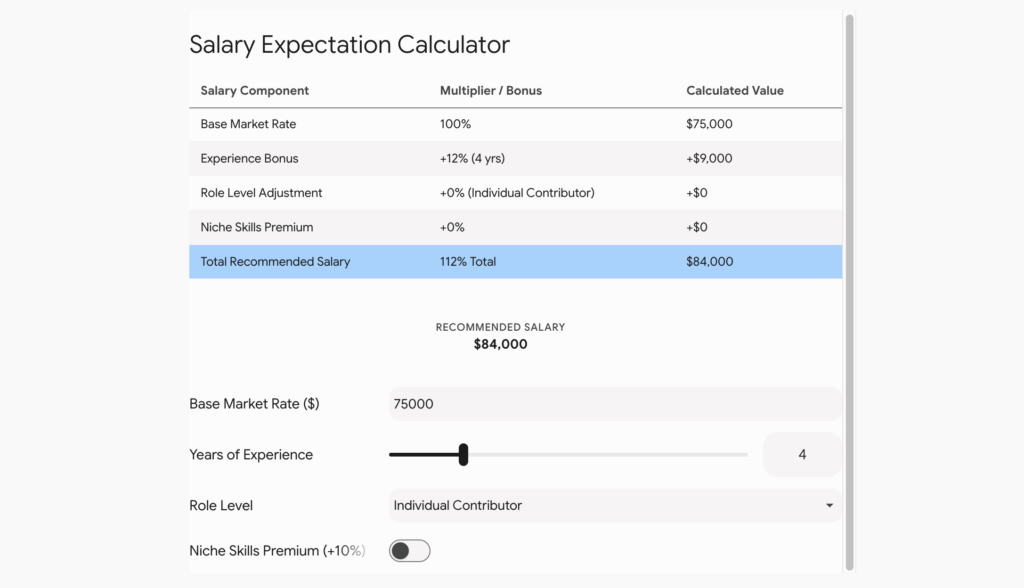
Use this interactive tool to visualize how your base rate scales with experience and added responsibilities: Click here
The Script: How to Answer the Question Technically
Once you have your number, you must deliver it with conviction. Never apologize for your rate.
Instead of saying, “I was hoping for around X…”, use a data-driven structure:
“Based on the current market data for this role in Lagos, and factoring in my [X] years of experience managing [specific high-value task], my expectation is between [Number] and [Number] net per month. However, I am open to discussing the total compensation structure, including bonuses and equity.”
This response achieves three things:
- It proves you did your research. You are citing the market, not your personal lifestyle needs. (Top firms verify everything anyway—as we detail in our piece on Biometric and Digital Identity Verification, so always ensure your past salary claims are truthful).
- It ties the number to the value you bring. You remind them why you are worth the premium.
- It leaves the door open for negotiation.
Employers respect candidates who understand their own market value. Calculate your worth accurately, anchor your number to data, and state it confidently. But note that some employers publish the salary range for the role, you might also want to use that as a guide when negotiating.
Want to work with an agency that advocates for fair compensation? Learn more about how we operate in our breakdown of the Best Recruitment Agencies for Fast Tech Hiring.